Showing posts with label National Romanization. Show all posts

Tuesday, January 19, 2016

Famous Politicians Who Use Gwoyeu Luomaatzyh 用拼調式羅馬拼音(國語羅馬字)拼姓名的政治人物

[Updated January 19, 2016]

In Taiwan, many important people use Gwoyeu Luomaatzyh/Romatzyh [tonal spelling, National Romanization] to spell all or part of their names. This includes politicians from major parties: the KMT 中國國民黨(Kuo Min Tang / Gwomindaang [guómíndɑ̌ng in Pinyin]), also called the Nationalist Party), the DPP 民主進步黨 (Minjinndaang, Democratic Progressive Party in English [Mínjìndɑ̌ng in Pinyin) and even the New Party. Here is a sample (CC pictures from Wikipedia):

Entire Names Spelled in Gwoyeu Romatzyh:

(1) Former Premier Jiang Yihuah 江宜樺, whose entire name is correctly spelled in National Romanization, is obviously a well-educated gentleman who pays attention to significant details. Premier Jiang's name would be Jiɑ̄ng Yíhuɑ̀ in Pinyin).
Premier Jiang Yihuah 江宜樺

(2) Wang Jinpyng 王金平, a modest, soft-spoken gentleman with a fine education, a former mathematics teacher who realizes the importance of noticing fine details: his entire name is correctly spelled in National Romanization (= Wɑ́ng Jīnpíng in Pinyin). Mr Wang is the President of the Legislative Yuan.
Wang Jinpyng 王金平 CC-BY-SA Rico Shen

Sunday, December 28, 2014

GL-6 Gwoyeu Row -iu- Finals 國語羅馬字 ㄩ 行韻母的標調法


In Gwoyeu Luomaatzyh (Gwoyeu Romatzyh, National Romanization), the high front rounded vowel (/y/ in IPA), is shown as two letters: iu. All 1st, 2nd and 3rd tone row -iu- finals show tone by changing the first letter of the medial vowel (i, y, e = 1st, 2nd, 3rd tone), rather than adding a letter, so they are printed in green. 4th tone finals show tone by adding one more letter at the end, so they are written in red.
國語羅馬字 ㄩ 行韻母大部分都是靠介音的改拼來標調 (iu, yu, eu = 一、二、三聲), 因此印成綠色。四聲韻母一律在末尾加字母,因此拼成紅色。

Saturday, December 27, 2014

GL-5 Gwoyeu Row -u- Finals 國語羅馬字 ㄨ 行韻母的標調法


In Gwoyeu Luomaatzyh (Gwoyeu Romatzyh, National Romanization), most row -u- finals show tone by changing the medial vowel (u, w, o = 1st, 2nd, 3rd tone), rather than adding a letter so they are printed in green. 

Gwoyeu Luomaatzyh -u- Row Finals (How to Show Tones) 國語羅馬字 -u- 行韻母的標調法
國語羅馬字 ㄨ 行韻母大部分都是靠韻母的改拼來標調 (u、w、o = 一、二、三聲), 因此印成綠色。

Wednesday, December 24, 2014

GL-2 Using Medial vowels to Spell Tones 用介音的拼法表示聲調


The basic form of National Romanization usually represents Mandarin first tone
國語羅馬字的基本形式通常代表國語的一聲(陰平):

千
川
圈
chian
chuan
chiuan

Mandarin second and third tone can be shown by changing the spelling of the medial vowel
國語的二、三聲(陽平、上聲)可以用介音拼法的變化來表示:


GL-1 Tonal Spelling for Mandarin Chinese: An introduction 拼調式羅馬拼音入門


Gwoyeu Luomaatzyh (GL for short; also called National Romanization, or Gwoyeu Romatzyh [GR]) is a national treasure, an ideal romanization for people beginning to learn Mandarin Chinese tones. It is highly recommended for teaching simple Chinese conversation to foreign friends. 國語羅馬字是國寶級羅馬拼音,是初次學習國語四聲(普通話四聲)的外國人一套理想羅馬拼音法,教外國朋友初級會話也非常值得採用。

GL uses special spellings to show the four tones of Mandarin Chinese. In order to understand why these spellings are used, one must have a basic understanding of the structure of Chinese syllables. 國語羅馬字用特殊拼法來標國語的四聲。欲了解國羅的拼法,對漢語的音節結構必須有初步的認識。

Each Chinese character usually represents one syllable. Chinese syllables can be made of three parts: An initial (= a consonant), a medial (= a semi-vowel) and a final (= a vowel, sometimes followed by -n or -ng). 通常每個漢字代表一個音節,而漢語的音節有三個成分:聲母(開頭的子音/輔音)、介音(半母音/元音)、韻母(主要母音/元音,有時候末尾還接 -n 或 -ng。
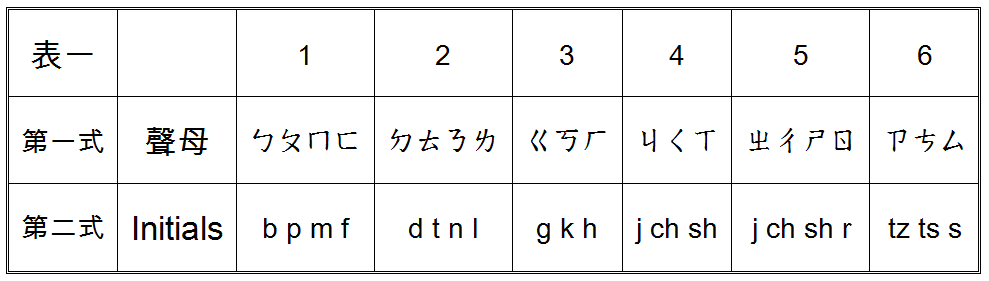
Chart 1, Gwoyeu Luomaatzyh Initials: Note that group 4 is *always* followed by -i or -iu, but group 5 is *never* followed by -i or -iu, so using "j, ch and sh" for both will never cause confusion.